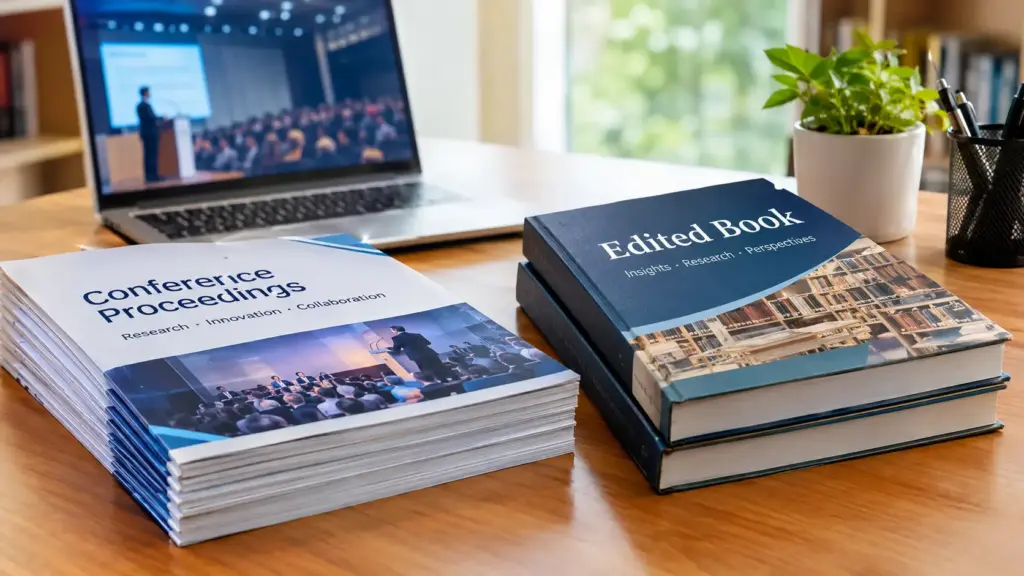

Conference Proceedings and Edited Book: what’s the difference between these two? That’s a question that runs through the mind of every researcher who wants to publish a paper in their field but doesn’t know which they should choose. This article aims on clearing this very doubt.
In this article, we are going to discuss exactly what these two are; we will also cover points including: what conference proceedings are and their steps, then we will discuss what is an edited book and its steps, then the key difference. And finally, do they overlap?
What are Conference Proceedings?
The papers that are selected by a particular conference’s organization compile all the papers. These are the published papers, with several authors.
One thing to keep in mind is that these conference proceedings don’t just carry different research papers. No! Each conference proceeding belongs to a particular conference and its organizers, and falls under a particular field of study. So it only contains the published papers that were presented at that particular conference. There are a few steps that the conference proceedings follow; let us discuss what those steps are:
Step 1: The first step is obvious: an organization or institution plans to organize a conference; for that, they start the planning, like when the conference should be held, what will be the field and the topics for the conference, and many more.
Step 2: After the conference is announced, several researchers (belonging to that field) who have papers that could be relevant to that conference, send their papers to the organizers, for review.
Step 3: The review process starts, where the organizers go through the submitted papers, checking if the papers are appropriate for the conference, or not? If the papers meet all the criteria of the conference, then the organizers select the papers for the conference.
Step 4: The next step takes place during the conference, where all the selected papers are presented before the attendees, and the researchers explain their research thoroughly.
Step 5: In this step, all the papers that were presented at the conference are sent for further editorial work. As there must be some kind of mistakes in these papers, the final editing before the publishing can correct the errors, change the formatting of the papers according to common standards, or general revisions of the papers.
Step 6: In the final step, all the papers that were presented at the conference are compiled together into the conference proceedings. And the conference proceedings are then published together (the publishing can be either online or offline, i.e., by printing)
What is an Edited Book?
An edited book is somewhat similar to the conference proceedings. Both of these carry all the research papers presented in a conference. In an edited book, several research papers are compiled into chapters, with each chapter is written by a different author. The editor, or editors, who compile these papers look for the the relevance of the papers to the targeted field and the topic.
All the chapters in an edited book must belong to a particular field or, shall we say, to a particular subject. But what the important thing to note here is that these books can be for a conference, or can be just an explanation of that subject and have nothing to do with any conference. Like Conference Proceedings, An Edited Book also follows a few steps, and now we will discuss what are the steps that an edited book follows?
Step 1: In the first step, the editor/editors decide what is the topic of the book will be. All the chapters (papers) what will they talk about? What will be their aim?
Step 2: Then the editor/editors decide how they will structure the book, where they check the themes of the chapters and decide which chapters explore the topic more effectively than the others.
Step 3: After the editors have structured the book, what they need next is writers, who will write these chapters. The editor can onboard a writer in two ways. One, the editors can call any researcher they know to come and write the chapters. Or two, the editor can announce a call for researchers and writers to write those chapters.
Step 4: After the call, many researchers and writers interested to pen write the chapters can contact the editors, sending them either a chapter proposal (a small summary of the chapter including all important details) or they can send the full chapter. After reviewing the interested writers’ work, the editor can decide which of the writers would be perfect to pen the chapters.
Step 5: After the editor receives the proposals from different writers, they review these chapters if the proposals align with what the book is trying to say, the editors may select some of the proposals while reject some more, and others are selected but may require a little change.
Step 6: This next step, the editor sends the chapters to an experienced researcher of that field, as a peer-review process. The researcher can go through the chapters and check the quality of the chapters. Then the researcher can share his feedbacks with the editor, explaining if the chapters are quality-wise well written and researched or not, if not, then what changes should be done.
Step 7: Now that the editor has received the feedback and told what changes must be done. It’s the editor’s job to communicate this to the writer, asking them to do the necessary changes as suggested by the researcher (the one who reviewed it)
Step 8: After the writers do the necessary changes to the chapters. The editor decides which the structure of the book, which chapters are discussing the topic more effectively than others, and the editor needs to decide if the chapter belongs to the first pages or the last. The editor needs to be a judge of all these decisions.
Step 9: Then the entire manuscript is edited yet again. This time, the editor checks whether or not the authors followed the rules and regulations. This includes the formatting and other important details.
Step 10: Finally, the complete manuscript is submitted to the publisher. Who after checking if the manuscript meets the requirements, proceed with it. And finally,y the manuscript is published.
Both Conference Proceedings and an Edited Book might seem like they have a lot of similarities, but they are not the same. They have a few differences that could clear this doubt: Are these two the same?
Key Differences Between Conference Proceedings and an Edited Book
They both have a compilation of papers; it’s true! But the purpose is completely different: conference proceedings belong to a specific conference, and they only have the published papers that were presented at the conference. Meanwhile, an edited book doesn’t belong to any conference; it compiles a few chapters written by different authors. All these chapters talk about the same topic,c and the book is compiled for the general public, who can read the book and increase their knowledge on that subject.
The selection process in both of these is also different. In conference proceedings, the researcher submits their papers according to the conference’s requirements. But in an edited book, it’s the editor who calls for writers to write a chapter of the book. Sometimes writers can also send proposals.
Next difference is, a conference proceedings also contains the papers that were presented in the conference, the only similarity between them belonging to the same field. Meanwhile, an edited book contains chapters that together explore the same subject and needs proper structuring rather than putting them randomly inside the book.
These were some of the key differences between conference proceedings and an edited book. But this may raise a question: do these two overlap?
Can Conference Proceedings and an Edited Book Overlap?
The answer to this question is yes! Conference Proceedings and an Edited Book can overlap. Many a times, conference approach a publisher who published an edited book containing chapters that can be relevant to the conference’s topic. And many other times, the papers that were presented at the conference are published as an edited book.